A useful AI agent skill is more than a long prompt: it is a compact operating manual for a specific task. The strongest skills tell the agent what to achieve, which inputs to use, how to make decisions and what the final output must look like.
A skill is a reusable set of instructions that guides an AI agent through a defined activity. Unlike a one-time request, it should work consistently across many similar situations. It turns an objective into a repeatable process.
Good skill design improves accuracy, predictability and maintainability. It also reduces unnecessary clarification, inconsistent formatting and unsupported assumptions.
1. Begin with one clear purpose
Start by defining the skill’s primary job in a single sentence. Name the intended task, target audience and expected outcome. If several unrelated goals appear in that sentence, divide them into separate skills.
A narrow purpose makes every later instruction easier to evaluate. A vague request such as “help with content” is less useful than “create a structured editorial blog for non-specialist readers from a supplied topic.”
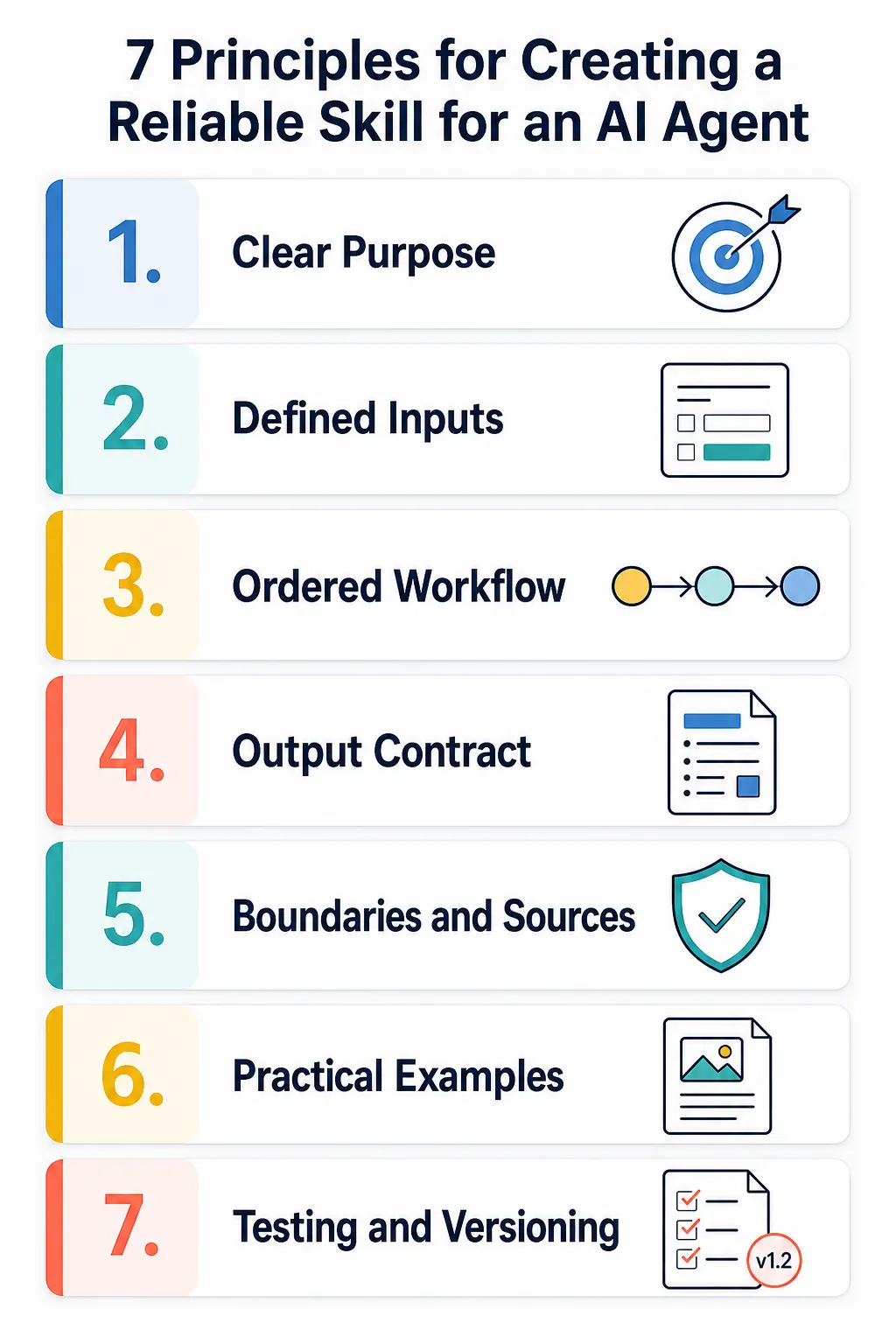
2. Define inputs before describing the process
Specify exactly which information the agent will receive. The skill should distinguish supplied data from information that the agent may select, calculate or derive.
Separate required inputs from optional inputs. Required inputs are necessary for completing the task correctly. Optional inputs may influence tone, length, language, audience or formatting.
Add a stopping rule for missing essential data. This prevents the agent from filling important gaps with guesses and gives the user a concise way to correct the request.
3. Turn the task into an ordered workflow
Give the agent a sequence of decisions rather than a loose collection of recommendations. Numbered steps help establish dependencies, especially when one action must be completed before another begins.
Keep each step focused on one operation. Put validation before generation when the agent needs to check data, permissions, dates or formatting requirements.
When conditional behavior is necessary, write it explicitly with clear “if” and “then” logic. A fixed decision path is easier to follow than an instruction such as “use your judgment when appropriate.”
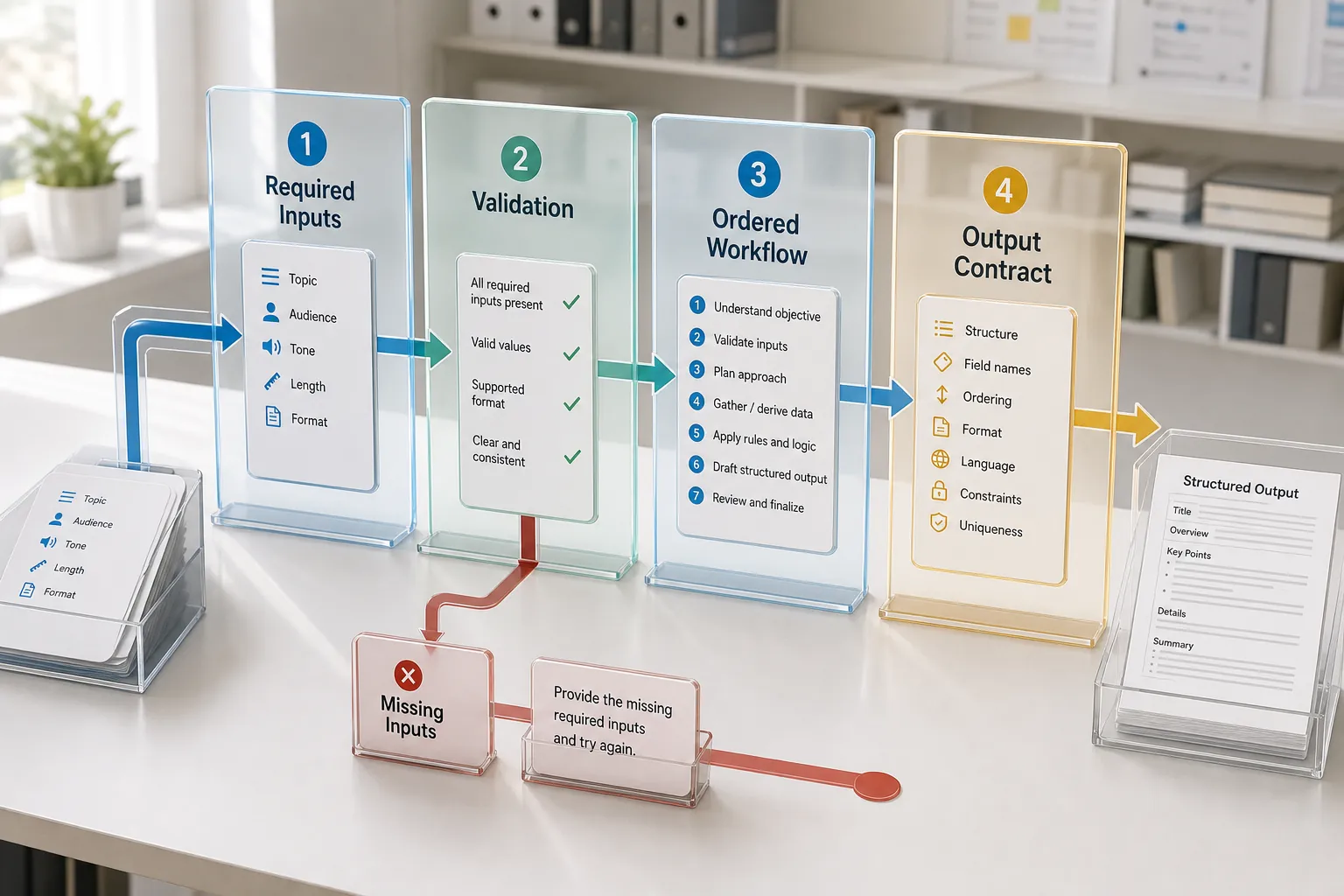
4. Specify the output contract
Define the exact structure of the final response. Include required headings, field names, ordering, file format, language and any elements that must appear only once.
Constraints should be measurable whenever possible. They can set a word range, number of sections, date format, allowed labels or required opening line.
Avoid relying on adjectives alone. A useful instruction combines a quality such as “concise” with a testable condition such as “use no more than three sentences per section.”
5. Establish boundaries and source rules
Skills need clear limits on what the agent may infer or invent. Instruct the agent to preserve supplied names, figures, categories and relationships exactly when they are important.
When missing information can be derived safely, explain the permitted method. If it cannot be derived reliably, require a missing-input response or a neutral omission.
For fact-dependent work, identify acceptable sources and explain when verification is required. Tell the agent how to handle conflicting evidence, unavailable data and time-sensitive claims.

6. Use examples as behavioral tests
Examples show how abstract instructions should work in practice. Include at least one realistic input and its correctly structured output when the format is complex.
A positive example demonstrates the desired behavior. A negative example can expose common errors, such as changing a supplied value, adding commentary outside the template or skipping validation.
Keep examples consistent with the written rules. An oversized example should not introduce requirements that are absent from the main instructions.
7. Test, revise and version the skill
Test the skill with normal, incomplete, ambiguous and unusually detailed inputs. Try cases that contain conflicting instructions or values close to an allowed limit.
Check whether the output is correct, structurally valid and consistent across repeated runs. Then revise the instruction that caused the failure instead of merely correcting one generated answer.
Version every meaningful change to a production skill. Record what changed, why it changed and which test cases confirm the improvement.
A compact example of an AI agent skill
The following example creates short product summaries from structured input. It includes a purpose, required data, a validation rule, an ordered process and a fixed output contract.
SKILL: Product Summary Writer
VERSION: 1.0

PURPOSE
Create a clear product summary for general online shoppers.

REQUIRED INPUTS
- product_name
- product_category
- key_features
- target_customer

OPTIONAL INPUTS
- tone
- maximum_word_count

VALIDATION
1. Check that every required input is present.
2. If a required input is missing, return only:
   MISSING_INPUTS: <comma-separated field names>
3. Do not generate the summary after a validation failure.

WORKFLOW
1. Identify the product’s main practical benefit.
2. Select the three most relevant supplied features.
3. Explain their value to the target customer.
4. Do not add specifications that are not present in the input.
5. Use the requested tone or a clear, neutral tone by default.

OUTPUT
# <product_name>

<one-sentence introduction>

## Key benefits
- <benefit one>
- <benefit two>
- <benefit three>

## Best suited for
<one or two sentences>

Maximum length: use the supplied maximum_word_count or 150 words.
Notice that each rule has a visible role in the final behavior. The agent knows when to stop, what it may use and how to organize the response.
The output contract also makes automated checking easier. The stopping rule prevents a polished but unreliable answer when required product information is absent.
A good AI skill combines clear intent with operational precision. It defines inputs, workflow, boundaries, output and validation without burying the agent in repetitive instructions. If examples and tests support those rules, the skill becomes easier to reuse and improve. The result is an agent that behaves more consistently while remaining flexible inside well-defined limits.