Synastry reveals how two individual birth charts interact when people enter a relationship. By comparing planets, aspects, houses and key chart points, it highlights attraction, emotional understanding, communication patterns and areas of growth. A thoughtful reading can help you understand why a connection feels easy in some places and demanding in others.
What synastry actually examines
Every relationship brings together two distinct personalities, needs and life rhythms. Synastry keeps both birth charts intact and studies the connections formed between them. It therefore shows how one person’s astrological energies activate the other person’s chart.
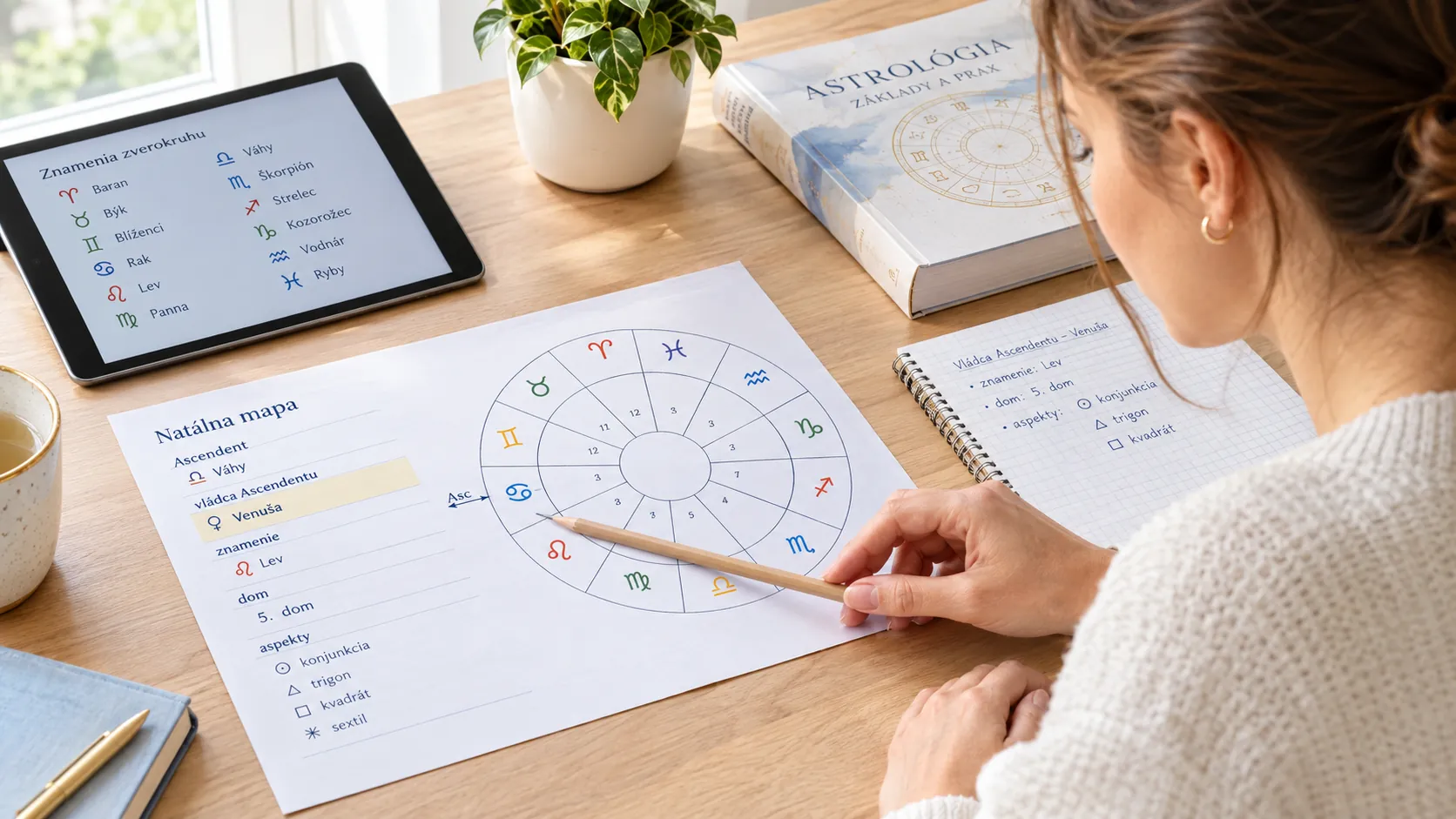
The process begins with accurate birth data for both partners: date, place and preferably exact time of birth. The time determines the Ascendant, house cusps and precise position of the Moon. When a birth time is unavailable, planetary aspects can still be examined, while house overlays require greater accuracy.
Synastry can be used for romantic couples, spouses, new partners and people considering a deeper commitment. The same method also works for friendships, family relationships and professional partnerships. In a romantic reading, the focus usually falls on emotional intimacy, attraction, communication, trust and long-term potential.
The first layer: planets and personal needs
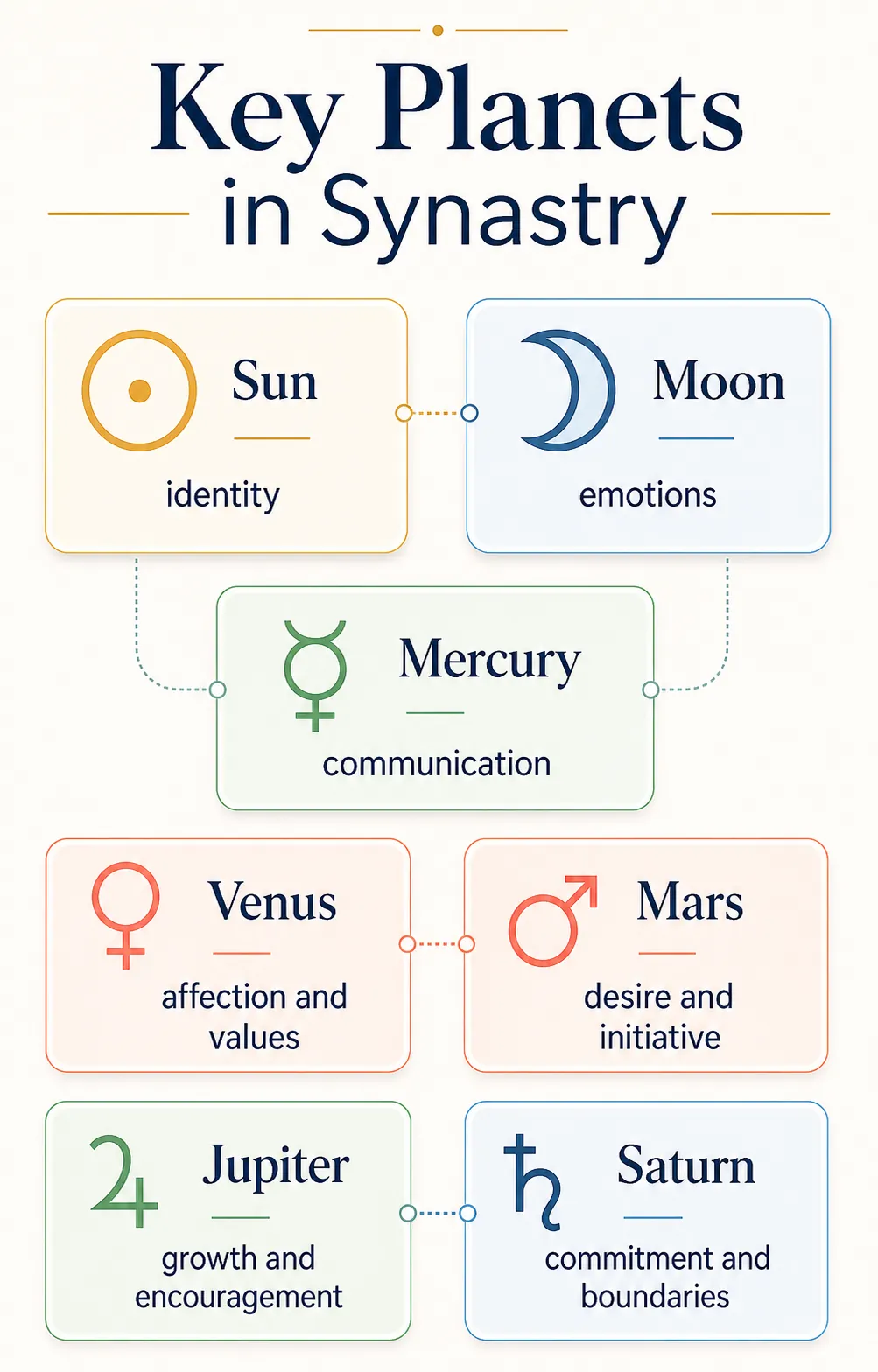
The Sun describes identity, vitality and the way a person naturally expresses purpose. Harmonious links between one partner’s Sun and the other person’s Moon, Venus or Ascendant often create recognition and mutual interest. Challenging Sun contacts can stimulate growth, especially when both partners respect their different ways of leading and making decisions.
The Moon represents emotional habits, instinctive reactions and the need for security. Moon-to-Moon aspects show whether two people process feelings at a similar pace, while contacts from Saturn, Uranus or Pluto can make the emotional bond more serious, changeable or intense. Because the Moon moves quickly, an exact birth time greatly improves the reliability of this part of the comparison.
Mercury reveals how each person thinks, listens and communicates. Supportive Mercury aspects encourage clear conversation and intellectual rapport, while tense contacts can produce misunderstandings, interruptions or sharply different reasoning styles. These patterns also show what kind of communication practice can help the couple cooperate more effectively.
Venus describes affection, pleasure, values and the way love is expressed. Mars adds desire, initiative, passion and the manner in which a person pursues what they want. Contacts between Venus and Mars are therefore among the classic indicators of attraction, although their expression depends on the signs, houses and other aspects involved.
Aspects reveal the dynamics between two charts
An aspect is an angular relationship between planets. In synastry, the astrologer compares the position of every relevant planet in one chart with the planets and angles in the other. The closer an aspect is to exact, the more noticeable its influence usually becomes.
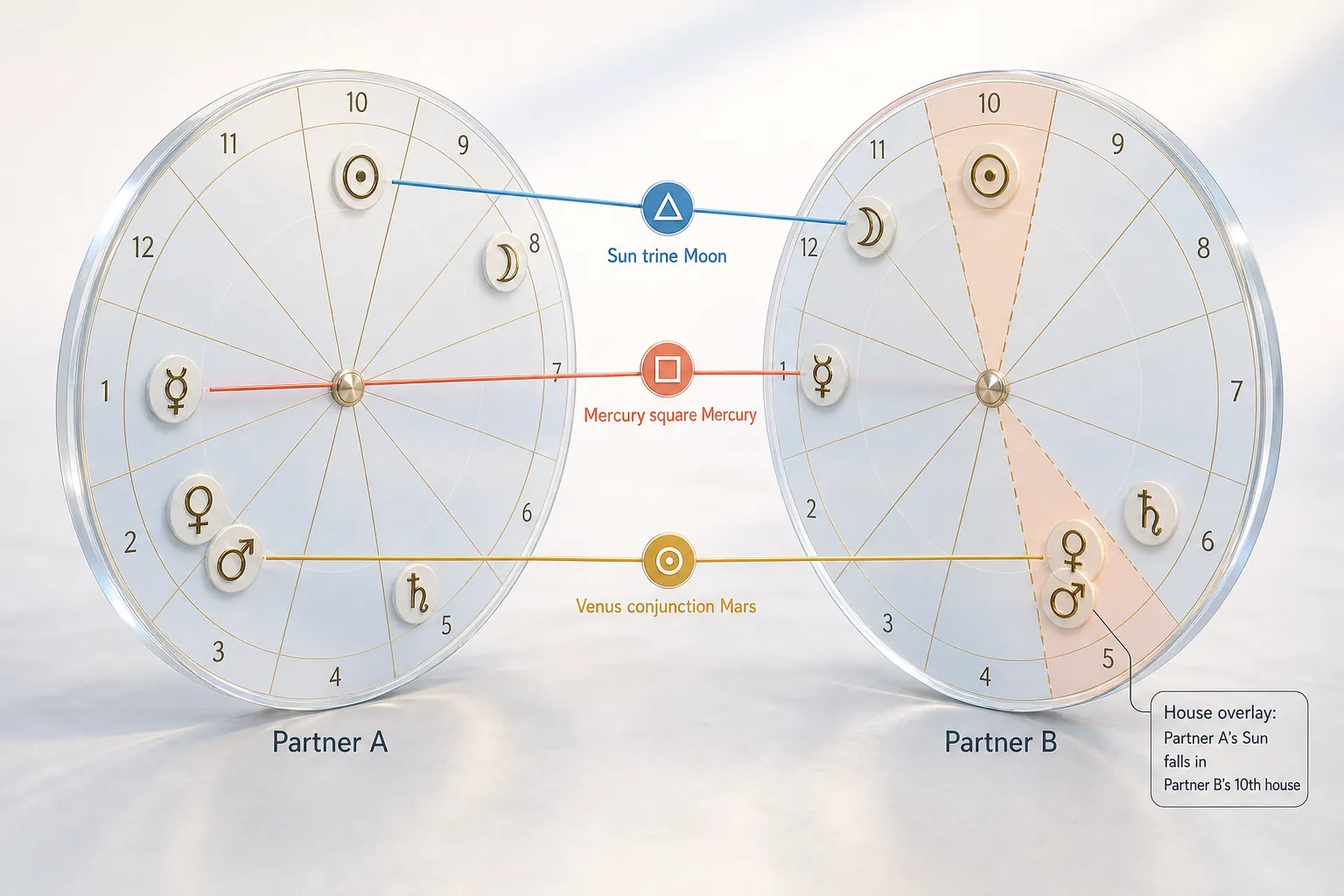
Conjunctions merge two planetary principles and make their interaction immediate. A Moon–Venus conjunction can support warmth and affection, while a Mars–Saturn conjunction may combine persistence with pressure or restraint. The result depends on which planets meet and how the partners already express them in their own natal charts.
Trines and sextiles tend to describe natural cooperation, ease and available talents. They can help partners feel understood without constant explanation, particularly when personal planets are involved. A relationship dominated only by easy aspects may feel comfortable, yet motivating contacts often provide the movement needed for development.
Squares and oppositions create polarity, friction and strong awareness of the other person. A Mercury–Mercury square can bring contrasting communication styles, while a Venus–Uranus opposition may intensify excitement and the need for freedom. These aspects become constructive when the couple gives their differences a clear and conscious form.
The astrologer also considers the orb, which is the distance between an aspect and its exact angle. Tight contacts involving the Sun, Moon, Ascendant, Venus, Mars or chart ruler usually deserve special attention. Wider aspects may remain relevant when they repeat an important relationship theme elsewhere in the comparison.
House overlays show where the relationship is felt
House overlays reveal where one partner’s planets fall in the other partner’s chart. They describe the life areas that become activated through the connection. This layer can explain why a person influences your confidence, home life, creativity, work, ambitions or private emotional world.
Planets in the first house can make the bond feel immediate and personal, while placements in the fourth house often touch family patterns and the need to belong. Fifth-house overlays highlight romance, pleasure and creativity, and seventh-house placements draw attention to partnership itself. Eighth-house contacts can deepen intimacy, shared resources and psychological transformation.
The tenth house brings visibility, goals and public direction into the relationship. The eleventh house connects the partners through friendship, community and future plans, while the twelfth house can reveal subtle emotional material that operates beneath everyday awareness. No house is interpreted in isolation, because the planet involved determines how that area becomes active.
Saturn, Jupiter and the outer planets
Saturn is closely associated with responsibility, structure, boundaries and endurance. Strong Saturn contacts can give a relationship commitment and staying power, but they may also expose fears, duties or imbalances in authority. A mature synastry reading examines whether Saturn creates dependable support or excessive limitation.
Jupiter expands whatever it touches and often brings encouragement, generosity, learning and shared confidence. Helpful Jupiter contacts can make partners feel that life offers more possibilities when they are together. Strong Jupiter energy also needs realistic direction so that promises, plans and expectations remain manageable.
Uranus awakens independence and change, Neptune heightens sensitivity and imagination, and Pluto intensifies psychological depth. Their contacts with personal planets can make a relationship feel exciting, idealised or profoundly transformative. Because these planets move slowly, their most personal influence appears when they closely contact the Sun, Moon, Mercury, Venus, Mars, Ascendant or Midheaven.
A practical method for comparing partner charts
Start by reading each natal chart separately. Identify the person’s relationship style through the Moon, Venus, Mars, seventh house, its ruler and major natal aspects. This step prevents one synastry contact from being given more importance than the individual charts can support.
Next, look for repeating themes between the two charts. A single Mercury–Saturn square may describe occasional caution in communication, but several Saturn contacts to Mercury, the third house and its ruler make communication discipline a central relationship lesson. Repetition gives an interpretation weight and clarity.
Then rank the connections by relevance and precision. Begin with close aspects between personal planets, the Ascendant, Descendant, Midheaven and house rulers before moving to broader generational contacts. Finally, connect the aspects with house overlays to understand both the quality of the energy and the area of life where it appears.
How to read compatibility as a whole
A strong synastry chart contains a mixture of attraction, support, contrast and development. Emotional compatibility may be excellent even when daily communication requires patience, while intense chemistry may coexist with different expectations about commitment. The most useful interpretation identifies both resources and pressure points without reducing the relationship to a single score.
It is also helpful to distinguish between chemistry and sustainability. Venus–Mars or Uranus contacts may create immediate attraction, while Moon, Mercury and Saturn connections often say more about emotional continuity, communication and responsibility.
Synastry becomes most valuable when you use it as a map for conscious partnership. If you enjoy the articles on our website and want to help us continue creating practical astrology content, you can support our future work.